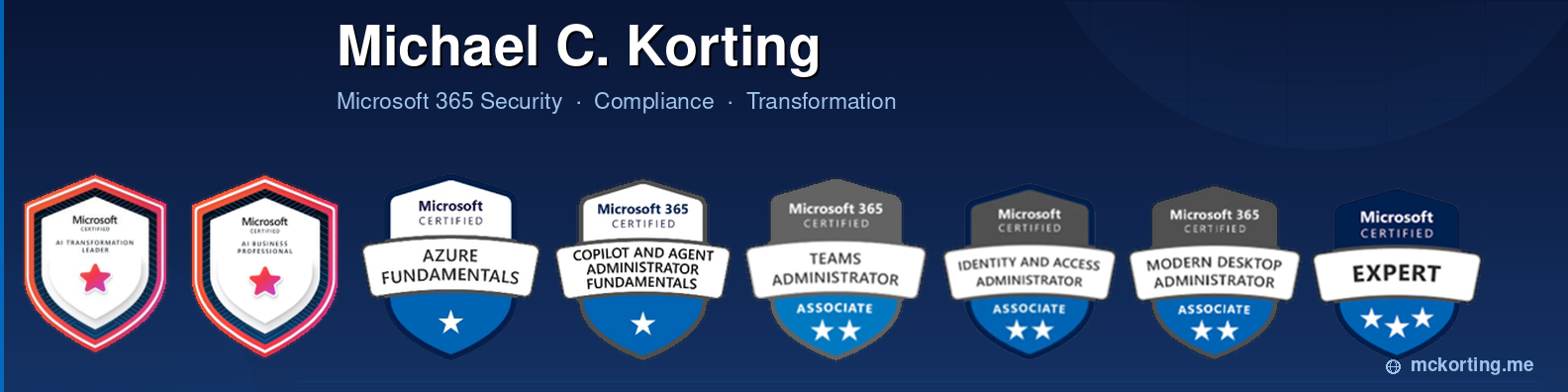

The Renewal Reminder Arrives
If you're like many Microsoft professionals, earning the MS-700: Managing Microsoft Teams certification was a significant milestone. It demonstrated your ability to deploy, manage, secure, and govern Microsoft Teams in modern organizations.
However, certification is not a one-time event.
Microsoft 365 changes at a remarkably fast pace. Features that did not exist a year ago can become standard practice. New compliance capabilities, governance controls, Teams Phone enhancements, and collaboration models are introduced continually. That is exactly why Microsoft encourages certification holders to renew their certifications regularly.
Recently, I completed my own MS-700 renewal assessment and was reminded of an important lesson: passing the original exam proves what you knew at one point in time, while renewal demonstrates that you are keeping pace with the platform as it evolves.
What the Renewal Focuses On
One thing I appreciate about Microsoft's renewal assessments is that they focus on current functionality rather than historical knowledge.
The topics I encountered reflected many of the capabilities organizations are actively implementing today, including:
Governance and Compliance
A significant portion of the assessment focused on protecting organizational data within Teams environments.
Topics included:
- Data Loss Prevention (DLP)
- Communication Compliance
- Sensitivity Labels
- Information Barriers
- External sharing controls
- Guest access management
These are no longer niche features used only by highly regulated organizations. Increasingly, they are becoming standard requirements for businesses of all sizes.
Organizations want collaboration, but they also want guardrails. Understanding how Teams interacts with SharePoint, OneDrive, Microsoft Purview, and Microsoft Entra ID is critical for designing secure collaboration solutions.
The Growing Importance of External Collaboration
Several questions centered around external collaboration scenarios.
This reflects a major shift in how organizations operate today. Teams is no longer just an internal communication platform. It is increasingly becoming the workspace used to engage with:
- Customers
- Vendors
- Consultants
- Contractors
- Strategic partners
As a result, administrators must understand:
- Guest access
- External access (federation)
- Shared channels
- B2B collaboration
- B2B Direct Connect
These features often appear similar at first glance, but they solve different business challenges. The renewal assessment reinforced the importance of knowing when each approach is appropriate.
Teams Governance Continues to Mature
Another area that stood out involved governance and lifecycle management.
Topics included:
- Team naming policies
- Blocked words
- Department-based naming conventions
- Sensitivity label deployment
- Policy assignment
- Guest controls
As Teams adoption grows, unmanaged environments can quickly become difficult to navigate. Effective governance helps organizations maintain consistency while still empowering users to collaborate.
The days of simply enabling Teams and hoping for the best are long gone.
Teams Phone Remains a Critical Skill
One area that has grown substantially since many professionals first earned MS-700 is Teams Phone.
Several renewal topics focused on voice workloads, including:
- Auto attendants
- Call queues
- Phone number assignment
- Calling Plans
- Teams Phone devices
- Routing methods
- Conference bridges
As organizations continue retiring legacy PBX systems, Teams Phone has become a core enterprise workload.
Understanding the differences between:
- Auto attendants
- Call queues
- Resource accounts
- Subscriber numbers
- Service numbers
is now essential knowledge for Teams administrators.
App Management and Policy Control
Microsoft continues to expand the Teams application ecosystem.
The renewal assessment also touched on:
- Teams app governance
- App permissions
- App subscriptions
- Policy packages
- Teams update policies
- Public Preview features
These topics remind administrators that managing Teams is about much more than meetings and chat. The platform has become a business application hub where governance and security are just as important as functionality.
Why Renewal Matters
The biggest value of certification renewal is not the credential itself.
The real value comes from forcing yourself to revisit areas of the platform that may not be part of your daily responsibilities.
Many administrators become highly specialized. Perhaps your organization doesn't use Teams Phone. Maybe you don't manage compliance. Perhaps you rarely work with external collaboration.
Renewal pushes you to revisit those topics and understand new developments that have emerged since your last certification cycle.
That broader understanding often proves valuable during architecture discussions, migration projects, and strategic planning efforts.
Lessons Learned
After completing the renewal assessment, a few themes stood out:
Microsoft Teams Is Increasingly a Governance Platform
Modern Teams administration extends far beyond chat and meetings. Security, compliance, retention, lifecycle management, and external collaboration are now central responsibilities.
Teams and Microsoft Purview Are Closely Connected
Many policy decisions involve multiple workloads working together:
- Teams
- SharePoint Online
- OneDrive for Business
- Exchange Online
- Microsoft Purview
Understanding these relationships is critical.
Voice Skills Continue to Gain Importance
Organizations deploying Teams Phone need administrators who understand both collaboration and telephony concepts.
Staying Current Matters
Features evolve quickly, and Microsoft's cloud services rarely stand still. What was best practice two years ago may no longer be the recommended approach today.
Final Thoughts
Renewing the MS-700 certification was a worthwhile exercise and an excellent reminder of how much Microsoft Teams continues to evolve.
The assessment reinforced the importance of maintaining skills across multiple areas, including governance, security, compliance, voice, external collaboration, and application management.
For anyone currently holding the certification, I would encourage you not to view renewal as simply maintaining a badge. Instead, treat it as an opportunity to validate that your knowledge reflects the realities of today's Microsoft 365 environment.
Technology changes. Platforms evolve. Customer requirements grow more complex.
Successful Teams administrators evolve right alongside them.
Certification: MS-700 Managing Microsoft Teams
Focus Areas: Governance, Compliance, Security, Teams Phone, Collaboration, Guest Access, App Management, and Policy Administration
Audience: Microsoft 365 Administrators, Teams Administrators, Solution Architects, and IT Consultants
Author Note: This article is based on a recent certification renewal experience and intentionally avoids sharing actual exam content while highlighting the general knowledge areas emphasized in the renewal process.