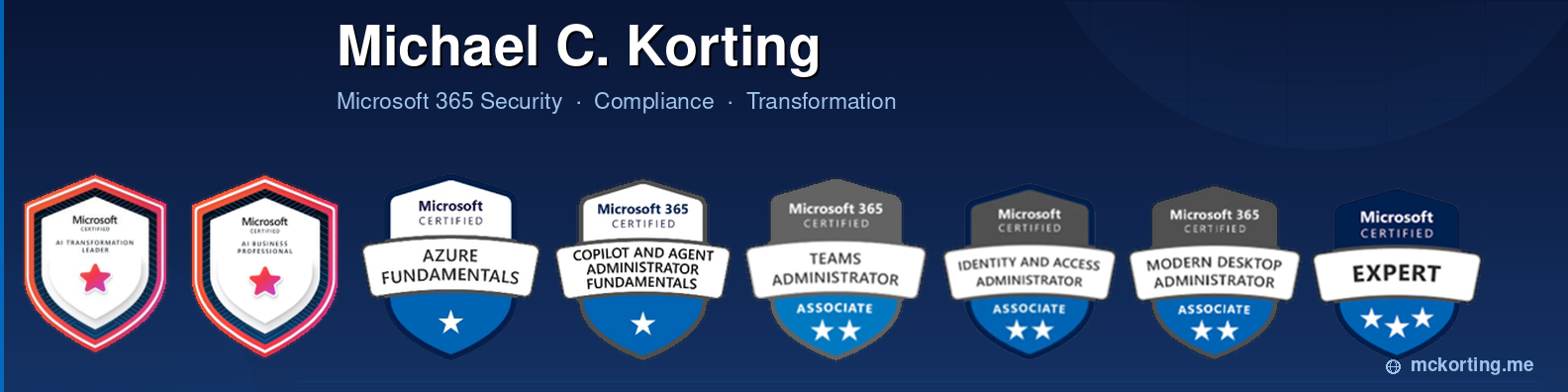

Passing AZ-900 in January
Earlier this year, I successfully earned the Microsoft Certified: Azure Fundamentals (AZ-900) certification as part of my ongoing professional development journey. While the certification is often described as an entry-level Azure exam, I found significant value in it because it helped organize and validate knowledge I was already using in real-world environments.
Over the years I have worked extensively within Microsoft 365, security, identity, endpoint management, migration projects, and collaboration technologies. Increasingly, many of those solutions interact directly with Azure services. Earning AZ-900 provided a structured framework for understanding the broader Azure ecosystem and the cloud principles that support modern Microsoft solutions.
Why Azure Knowledge Matters
Even professionals whose primary focus is not Azure administration benefit from understanding cloud concepts. Today's environments routinely combine Microsoft 365, Entra ID, Azure resources, APIs, automation, storage services, monitoring platforms, and cloud-hosted applications.
AZ-900 helped reinforce core concepts that influence nearly every modern Microsoft deployment:
- Cloud computing models
- Azure architecture fundamentals
- Identity and security concepts
- Networking basics
- Storage services
- Governance and compliance
- Cost management and operational responsibility
- Resource organization and management
These concepts become increasingly important as organizations continue their cloud adoption journeys and blend traditional infrastructure with modern cloud-native services.
The Microsoft Learn Training Paths
One of Microsoft's greatest strengths is the availability of free, high-quality training through Microsoft Learn. My preparation largely centered around completing the official learning paths and reinforcing areas through hands-on experience.
1. Describe Cloud Concepts
This section provides the foundational cloud knowledge that underpins every Azure service.
- Public cloud
- Private cloud
- Hybrid cloud
- Scalability
- Elasticity
- High availability
- Disaster recovery
- Business continuity
2. Describe Azure Architecture and Services
The second major area focuses on the Azure platform itself and introduces many of its core building blocks.
- Regions and Availability Zones
- Resource Groups
- Azure Resource Manager
- Virtual Machines
- Storage Accounts
- Networking Services
- Containers and Application Hosting
- Identity Services
3. Describe Azure Management and Governance
The final major learning area addresses operational management and responsible cloud administration.
- Role-Based Access Control (RBAC)
- Azure Policy
- Resource Management
- Cost Management
- Monitoring and Reporting
- Compliance Controls
- Subscription Governance
How Azure Appears in My Professional Work
One reason AZ-900 resonated with me is that it directly connected to technologies I already use professionally. A recent example involved working with Azure Communication Services Email. While consuming the service may seem straightforward, understanding subscriptions, resource groups, networking, authentication, monitoring, and governance provides valuable context when designing and supporting Azure-based solutions.
How Azure Supports My Personal Projects
Azure is not only part of my consulting and engineering work — it is also a major component of my personal technical projects. For example, this website and blog leverage Azure services as part of a modern cloud-hosted architecture. I have also built several personal applications using:
- Azure Static Web Apps
- GitHub-integrated deployments
- Serverless APIs
- Cloud-hosted dashboards
- Storage-backed solutions
Working with Azure Static Web Apps has provided practical exposure to resource management, deployment automation, security considerations, and scalable cloud hosting — many of the same concepts covered throughout the AZ-900 curriculum.
Preparation Strategy
- Complete the Microsoft Learn training paths.
- Review official study materials.
- Use the Microsoft practice assessment.
- Connect exam concepts to real-world Azure experiences.
- Focus on understanding concepts rather than memorization.
Why I Recommend AZ-900
If you work anywhere within the Microsoft ecosystem, Azure knowledge becomes increasingly relevant. Whether your focus is Microsoft 365, security, data, development, infrastructure, or consulting, understanding Azure fundamentals helps build a stronger technical foundation.
Final Thoughts
Looking back, earning AZ-900 in January was an excellent investment. It validated foundational cloud knowledge, strengthened my understanding of the Azure ecosystem, and provided additional context for technologies I use both professionally and personally.